On the surface he seems to be expressing doubt or uncertainty, but in reality it is a humble faith statement. He does not presume upon God, but rather speaks from humility, dependence, and submission.
God Will Make A Way
Absorbing What Is Taught
Zoned for Purity
Have you ever read a description of an imagined society, perhaps Plato’s utopia ruled by philosophers, or some other example? Or, going a different route, has a child ever drawn a city and shown it to you, perhaps with a single hospital and a block of farmland off to one side – in fact, often most things set up as blocks right next to each other, rarely with any attention given to parking or railway stations.
Reading Ezekiel 45-48, the third part of his final vision, reminded me of both these things. The vision’s focus shifts to zoning: land set aside for the Temple, priestly and Levitical residences, the city of Jerusalem, property for princes, and land for the regular people. And in the last part of the book, land for each tribe. This is laid out down to the cubit, with right angles, like it might be in a child’s drawing. And the social groups are assumed to remain separated and balanced, as in proposals for utopian societies. Perhaps it isn’t meant to be treated as a practical description, but more to say “God has not forgotten anyone, and all will get what they need.”
The description of Israel’s society here emphasizes improvement, with comments like:
“My princes shall no longer oppress My people, but they shall give the rest of the land to the house of Israel according to their tribes” (45:8b). The powerful will not act for their own benefit, and all of the tribes would get what they needed, though in Ezekiel’s time most of the tribes were scattered – so the vision itself is promising the regathering of the tribes.
“You shall have just balances, a just ephah and a just bath. The ephah and the bath shall be the same quantity” (45:10-11a). This comment rebukes theft by cheating in business. Weights on sets of balance scales were used to calculate payments. By using differing sets of weights that looked the same, a merchant could vary which they used when buying or selling to unfairly benefit in every transaction.
Similarly, “ephah” and “bath” were supposed to be the same volume – apparently about 22 liters – just with one measuring dry goods like grain (that might be in sacks or baskets) and the other measuring liquids like oil or alcohol (perhaps kept in stone jars).
The last part of chapter 45, and chapter 46, contains more about God’s expectations for honorable and pure actions by the prince and the priests, which circles back to the Temple’s layout. Washing at the Temple had always required a great deal of water, brought there with difficulty. But here this issue of purifying water is reversed, it is not brought into the Temple but flows from it and will affect the nations.
“By the river on its bank, on one side and on the other, will grow all kinds of trees for food. Their leaves will not wither and their fruit will not fail. They will bear every month because their water flows from the sanctuary, and their fruit will be for food and their leaves for healing.” (47:12)
I have previously cited the estimate that the book of Revelation contains over five hundred references to other biblical texts which are not direct quotations. And, to save you looking it up, here is the similar language to Ezekiel 47:12 in Revelation:
“Then he showed me a river of the water of life, clear as crystal, coming from the throne of God and of the Lamb, in the middle of its street. On either side of the river was the tree of life, bearing twelve kinds of fruit, yielding its fruit every month; and the leaves of the tree were for the healing of the nations.” (22:1-2).
The two quotes share many details, but they also differ. In Ezekiel, for example, the water comes from under the wall of the Temple and then deepens to become a river. The Revelation text involves the huge New Jerusalem, while the “18,000” cubits of the city mentioned in Ezekiel 48:35 is a bit under six miles. Such issues are another reason to question whether the vision is to be taken as about the precise details of future events or themes of purity and redemption.
A message of purity and redemption for the exiles flows through the text. They were torn from their people and their land, forced even to hear about the destruction of their city and its Temple at a distance. They mourned in exile. But God intended to restore what was broken – including the people. God’s people had been broken long before, that is why the exile took place. Exile was part of the penalty God kept putting off generation after generation, though ultimately God’s words had to be fulfilled. But now God was again offering the people an opportunity to live as they should, interacting in purity, they and their princes, priests, and merchants. And no matter how many more times those relationships were damaged, God was committed to them being set right. God’s name was to be exalted, and the people who lived where God’s name dwelled needed to be purified, in keeping with that city being known as “ ‘The Lord is there.’ ” (Ezekiel 48:35b).
©Pastor Daniel Smead, 2025
God Responding to Prayer
We may not always truly believe that God will answer as we ask. As we pray for those who are seriously ill - even mortally so - we may not fully believe God will miraculously act. Perhaps we dare not be so bold in prayer because we sense it will reflect poorly on God’s reputation if He does not act as we ask.
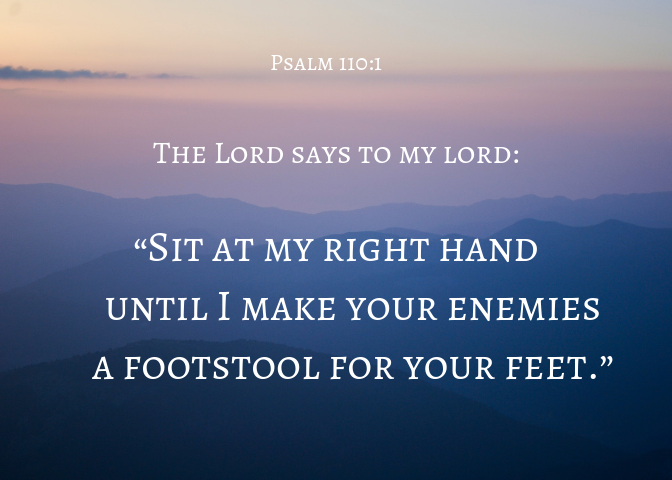
God’s Throne, and the Soles of God’s Feet
Barnabas
Pay Attention
Fear Has Lost It’s Hold On Me
Preparing for the Storm Through Fasting
A day that will live in infamy. President Franklin D. Roosevelt said something very close to this after the attack on Pearl Harbor on December 7th, 1941. Another day that lives in infamy is the one that we remember today, Good Friday. A funny name for a day that doesn’t seem so good on the surface, we read the account in scripture of Jesus being betrayed, arrested, mocked, beaten, harassed, and ultimately executed by the state at the behest of the people (heavily influenced by the Jewish rulers). That doesn’t seem very good. However, the goodness is in the plan of God, that he used the blood of Jesus that was shed that day to cleanse the sins of the world.
In the Presence of My Enemies
Everyone loves a good underdog story. Whether it’s David vs. Goliath or the “Miracle on Ice,” it’s easy to root for disadvantaged heroes who overcome the odds to find triumph. It’s one of the reasons I love the movie Rocky so much. Can anything take its title as the best modern-day underdog movie? I challenge you to name a better one!
Holding Strong
Jesus tells us that in this world, we will have tribulation. The NIV version translates “tribulation” as “trouble”, but it is more than that. Tribulation is defined as: afflictions, severe trials, or deep suffering, often used to describe overwhelming distress or persecution. Tribulation doesn’t sound like a pleasant picture, and it is not. But Jesus also tells us the words he spoke, recorded in the Bible, are to give us peace.
With Everything Inside of Me
f we’re honest, we like being in control.
It can look different in each of us. You like having a plan, knowing what’s next; or maybe it’s feeling like if you just try hard enough, do everything right, pray just the right words, you can manage the outcome. But surrendering to God means releasing our illusion of control.
My Weapon is a Melody
Who Will Stand in the Gap?
Consequences for Evil Overflow
Over and over God provided for His people, over and over He warned them to get rid of their idols, keep His commands and observe His Sabbaths. Over and over Israel failed to obey God and experienced the consequences. Over and over God was compassionate and loving and forgave His people and restored them to blessings.
Learning Before Serving
The historic fact of Jesus’ resurrection from the dead is well verified, but it means little unless it is personally experienced. A dynamic personal encounter with the risen Christ is key. But this personal encounter must be grounded in training. Until we “go to school” with Jesus, and are thoroughly taught truth by Him, we are not ready to serve Him.
God of Mercy. God of Justice
Each person is responsible for their own actions. Parents are not held responsible by God for the sins of their children, and children are not held responsible by God for the sins of their parents. Each person is responsible for their own behavior. In the same way, you don’t get credit for your parents good behavior if you do bad. Each person is responsible for their own sin and will be judged accordingly.
March 14th - The Bible is True
Now in 8th grade, I was listening to the Math teacher, taking notes and totally absorbed in “math”. The teacher was talking about historical representations of Pi. Then I almost fell out of my seat when he said that the Bible said Pi was 3. I mean no one talks about the Bible in school, let alone Math.