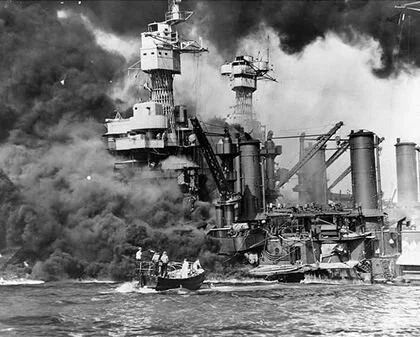
A day that will live in infamy. President Franklin D. Roosevelt said something very close to this after the attack on Pearl Harbor on December 7th, 1941. Another day that lives in infamy is the one that we remember today, Good Friday. A funny name for a day that doesn’t seem so good on the surface, we read the account in scripture of Jesus being betrayed, arrested, mocked, beaten, harassed, and ultimately executed by the state at the behest of the people (heavily influenced by the Jewish rulers). That doesn’t seem very good. However, the goodness is in the plan of God, that he used the blood of Jesus that was shed that day to cleanse the sins of the world. Importantly, the exclamation point of Good Friday is not felt until Easter or Resurrection Sunday. But how on earth did Jesus’ face this? How was he able to face the fire that was before him and submit to God’s will to be the sacrifice for sin?
While there are many individuals who have run into danger to save others, to put themselves on the line, this often takes preparation. Police officers and firefighters have lots of training and tools to prepare them. Soldiers going off to war have lots of preparation. It is not just physical preparation, but also psychological preparation. How do you set yourself up to run into terrifying and often lethal situations? How do you set aside your desires, especially the desire to live, to put your life on the line?
“And when you fast, do not look gloomy like the hypocrites, for they disfigure their faces that their fasting may be seen by others. Truly, I say to you, they have received their reward. But when you fast, anoint your head and wash your face, that your fasting may not be seen by others but by your Father who is in secret. And your Father who sees in secret will reward you. (Matthew 6:16-18 ESV)
Fasting is one way that we can prepare to do hard things. In short, fasting is giving something up so that we can focus on something else. Before Jesus began his ministry, he went out into the wilderness and fasted. This prepared him for the difficulties ahead by experiencing difficulty voluntarily in the present and placed him in a dependent state to look toward God, and focus on the difficult road ahead.
When we think about fasting, we typically think about giving up food, and that is the model that we see in scripture. We need food. Our bodies don’t like it when we don’t give it sustenance. Our bodies react and tell us, “Hey, I need some food here, buddy.” Going without food for prolonged periods, and sometimes even short periods, can be uncomfortable, even painful. But it forces us to focus on other things to get our minds off the hunger.
The purpose of biblical fasting is to get us to rely on God. It should strengthen our prayer and cause us to present ourselves before God in humility. As we are dependent on food to sustain us physically, we are dependent on God to sustain us spiritually. God made us in his image and to relate to him. When we fill our lives with the many distractions and activities of our age, we can easily lose that sense of reliance on God. Life is so convenient with our advances in technology, but comfort and convenience aren’t always good things. It lulls us into a place of feeling safe, yet we are not safe. There are spiritual attacks that target us and if we are estranged from God in any way, we are at a grave disadvantage. Fasting shocks our system into recognizing what it is like to be in need, to feel discomfort, to be dependent on something or someone.
And Jesus said to them, “Can you make wedding guests fast while the bridegroom is with them? The days will come when the bridegroom is taken away from them, and then they will fast in those days.” (Luke 5:34-35 ESV)
Richard Foster wrote that the spiritual disciplines, to which fasting belongs, are meant to put us in a place where God can change us. So, when we fast with spiritual intentions, it does just that. It puts us in a place of vulnerability, where God can work on our hearts and draw us into a deeper relationship with him.
“Do not lay up for yourselves treasures on earth, where moth and rust destroy and where thieves break in and steal, but lay up for yourselves treasures in heaven, where neither moth nor rust destroys and where thieves do not break in and steal. For where your treasure is, there your heart will be also. “The eye is the lamp of the body. So, if your eye is healthy, your whole body will be full of light, but if your eye is bad, your whole body will be full of darkness. If then the light in you is darkness, how great is the darkness! “No one can serve two masters, for either he will hate the one and love the other, or he will be devoted to the one and despise the other. You cannot serve God and money. (Matthew 6:19-24 ESV)
Fasting also helps us to realize what Jesus is talking about in the above passage.
Thinking and focusing on what is important. What value do we put on food versus what God provides for us? Many verses talk about giving in scripture, giving to help others rather than accumulate “stuff” that we probably don’t need and overvalue. Fasting can point us to the treasure of eternal life in the Kingdom of God, rather than the “treasures” of our technologies, relative safety, and creature comforts.
Food isn’t always a good option for fasting. Some people have health issues that make it unwise and children are growing and probably shouldn’t go a day or more without food. But in practicing fasting, you can give up certain types of food. Go a day, a week, maybe even longer, without your favorite meal or treat. Maybe children can give up sugary snacks (better for them anyway) as a means of experiencing fasting. Give up TV, Facebook and other forms of social media, give up doomscrolling and spend some time filling those wasted hours with bible reading or praying. When you crave the thing that you are fasting from, that is your cue to withdraw to a place where you can commune with God and Jesus free from the distraction or comfort-item that you turn to for fulfillment.
Finish up your devotional time by reading Psalm 25 (in your own Bible or on the following page) and then spend some time in prayer. As you read it, circle or highlight the language that shows our reliance on God. Ask God to enter into your hearts and shape your paths so that you may do His will.
To you, O LORD, I lift up my soul.
O my God, in you I trust; let me not be put to shame; let not my enemies exult over me. Indeed, none who wait for you shall be put to shame; they shall be ashamed who are wantonly treacherous.
Make me to know your ways, O LORD; teach me your paths.
Lead me in your truth and teach me, for you are the God of my salvation; for you I wait all the day long.
Remember your mercy, O LORD, and your steadfast love, for they have been from of old.
Remember not the sins of my youth or my transgressions; according to your steadfast love remember me, for the sake of your goodness, O LORD!
Good and upright is the LORD; therefore he instructs sinners in the way.
He leads the humble in what is right, and teaches the humble his way.
All the paths of the LORD are steadfast love and faithfulness, for those who keep his covenant and his testimonies.
For your name’s sake, O LORD, pardon my guilt, for it is great.
Who is the man who fears the LORD? Him will he instruct in the way that he should choose.
His soul shall abide in well-being, and his offspring shall inherit the land.
The friendship of the LORD is for those who fear him, and he makes known to them his covenant.
My eyes are ever toward the LORD, for he will pluck my feet out of the net.
Turn to me and be gracious to me, for I am lonely and afflicted.
The troubles of my heart are enlarged; bring me out of my distresses.
Consider my affliction and my trouble, and forgive all my sins.
Consider how many are my foes, and with what violent hatred they hate me. Oh, guard my soul, and deliver me! Let me not be put to shame, for I take refuge in you.
May integrity and uprightness preserve me, for I wait for you.
Redeem Israel, O God, out of all his troubles. (Psalm 25:1-22 ESV)
© JJ Fletcher, 2026
Questions to Consider:
1. How have you prepared your heart for remembering the death of Jesus?
2. What spiritual disciplines helped Jesus strengthen his endurance as he faced death on the cross?
3. Raise a Hallelujah has a line that says “I’m gonna sing in the middle of the storm”. In other devotions this week, we talked about the storm coming and ways we can stand firm. Fasting is yet another way to be able to sing in the storm with our feet planted. What are things you have done to help sing inside the storm and prepare for anything that might come your way?
Worship Together:
Step by Step - Rich Mullen
Come to the Table - Sidewalk Prophets
Big House - Audio Adrenaline